
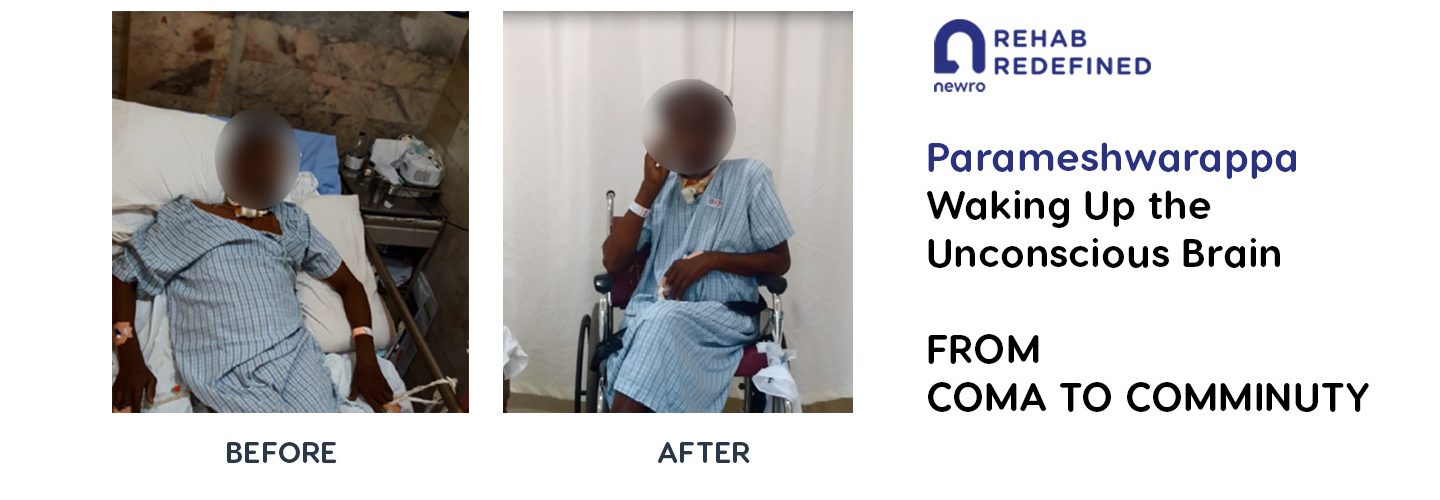
Parameshwarappa, a 50 year old agriculturist, father of an ESI beneficiary, suffered a severe Traumatic Brain Injury following a road accident. He was in deep coma since then. He initially underwent a major brain surgery (craniotomy) to remove clots in his brain and ICU/ Ventilator management in another hospital and was brought to our IP rehab services for further management. At the time of evaluation at our hospital, he was deeply unconscious or in coma, with a Glasgow Coma Score (GCS) of 6T/15, with a right hemiparesis (weakness of the right upper and lower limbs), on an NG tube and tracheostomy. He was bedridden. He was very restless and needed constant restraint.
#severeTBI #DECRA #coma #unconsciousness
The advanced neuro rehabilitation focussed extensively on coma stimulation during the initial weeks of therapy, using the WUUB protocol (Waking Up the Unconscious Brain). At first, Parameshwarappa’s recovery was questionable, and many doctors and even the caregivers felt that we were ‘wasting our time’, but the ‘never-say-die attitude’ of team NewRo began paying off! Weeks of gruelling sessions of speech, physical and occupational therapy soon began to show small and incremental results and ‘hope’ returned.
He began to open his eyes and slowly track objects. He was able to move all four limbs restlessly. His swallowing reflex became more consistent.
#neversaydieattitude #WUUB #comastimulation
Witnessing his progress was motivational for the caregivers and therapists. Cognitively, his responses become more purposeful and oriented. He shook hands with people and responded with a smile. He was able to sustain adequate breath support and subsequently tracheostomy was closed as per the VOST protocol. He soon began to vocalise words. He was started on oral feeds and within few days he began to eat regular food.
#VOSTprotocol #cognitivetherapy
His upper extremity strength improved. He was able to use his hands inconsistently for activities of daily living (ADL) such as eating, dressing and grooming. Physically, he was able to sit, stand and walk independently at which time he was discharged from the hospital.
#ADL #sittingbalance #standingbalance #walkingbalance #FULL #FBL
Out-Patient and home-based rehabilitation was continued and he continued to show remarkable progress. He is currently able to walk around independently, speak coherently (though not yet normal) and take care of all his Activities of Daily Living (ADL), independently. He has control over his bladder and bowel and his behavior has stabilized.
Since they come from an economically weaker section of society, his ability to manage himself independently was critical for the family’s functioning and survival.
#speechtherapy #FIL4





Add comment